

Produced by FT Strategies in partnership with WAN-IFRA, and supported by Arc XP, the Future Newsrooms Study 2026 examines how newsrooms are shaping their editorial strategy and positioning themselves for the future in response to shifts in audience behaviour and rapid technological developments. The report sheds light on a critical question that leaders must ask themselves: how are news organisations defining, protecting and operationalising their editorial value in an age of content abundance?
Based on survey data from 448 unique respondents across 86 countries, guidance from a 10-member advisory board made up of editorial, strategy, innovation, product and AI leaders from across the news industry and within academia and qualitative interviews with 16 editorial and executive news leaders around the world, this inaugural report identifies where the news industry as a whole is heading next — and four crucial gaps that newsrooms must address in order to meet the moment.

What's inside the report
Our findings show that newsrooms recognise the need to become more audience-led, distinctive and better equipped for the AI era. At the same time, they are hindered by structural, cultural and organisational barriers that risk slowing progress.
The Future Newsrooms Study 2026 is divided into four chapters that correspond to key gaps we identified in our research:
- The Strategy Gap | Although newsrooms claim to have a strategy, many continue to struggle with cascading strategic mandates into everyday editorial decision making. This chapter explores concepts such as strategic–editorial alignment, portfolio discipline and the shift from reach to audience engagement — as well as where AI falls short in matching up to wider strategic ambitions in the news industry.
- The Audience Trust Gap | Newsroom leaders recognise the importance of building audience trust, but their structures and ways of working are making this difficult to deliver consistently. This chapter examines the role mechanisms such as transparency, expertise, usefulness, affinity and journalist–audience relationships play in establishing greater trust, and how newsroom approaches to storytelling must evolve as a result.
- The Capability Gap | Shifts in the information environment require changes to editorial structures, workflows, tools and decision making processes, but newsrooms have been slow to foster the conditions that allow for transformation at pace. This chapter highlights the space, ownership and support structures that instill greater confidence in newsroom leaders and enable their people to make the most of new technologies and opportunities.
- The Skills Gap | A future-ready newsroom must feature a future-ready workforce. While fundamental reporting skills remain essential, newsrooms must also cultivate a wider range of technical, commercial and audience-centric skills in order to thrive. This chapter identifies the emerging skill sets expected of journalists (such as AI literacy, niche expertise and creator-style journalism) as well as the approaches newsrooms are taking to developing these skills.
Five key charts from the report
Strategy is becoming more audience-led, but execution is uneven…
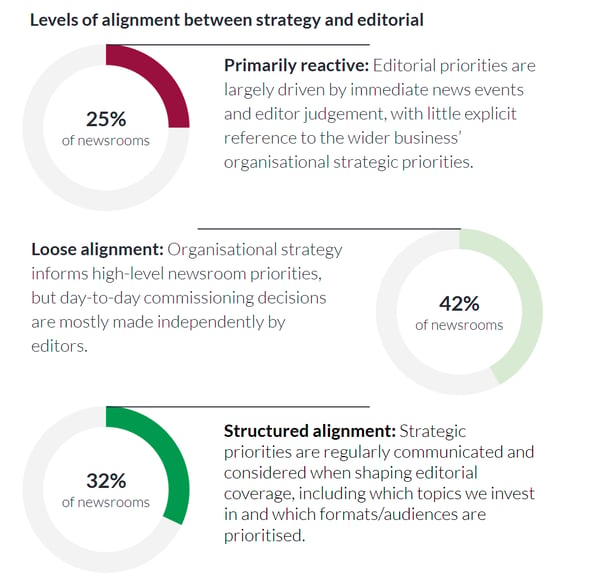
…and that cascade matters to editorial budgets
Audience-first language is rarely being matched by audience-first workflows
AI adoption is being slowed by people and process, not just technology
Distinctive journalism is becoming more visual, explanatory and community-led
The Future Newsrooms Study 2026 brings together global survey data, strategic frameworks, case studies and practical implications for news organisations rethinking how they operate. Download the full report to explore where newsrooms must place their focus in order to remain sustainable, what is holding them back and how the most aligned organisations are transforming strategy into everyday practice.