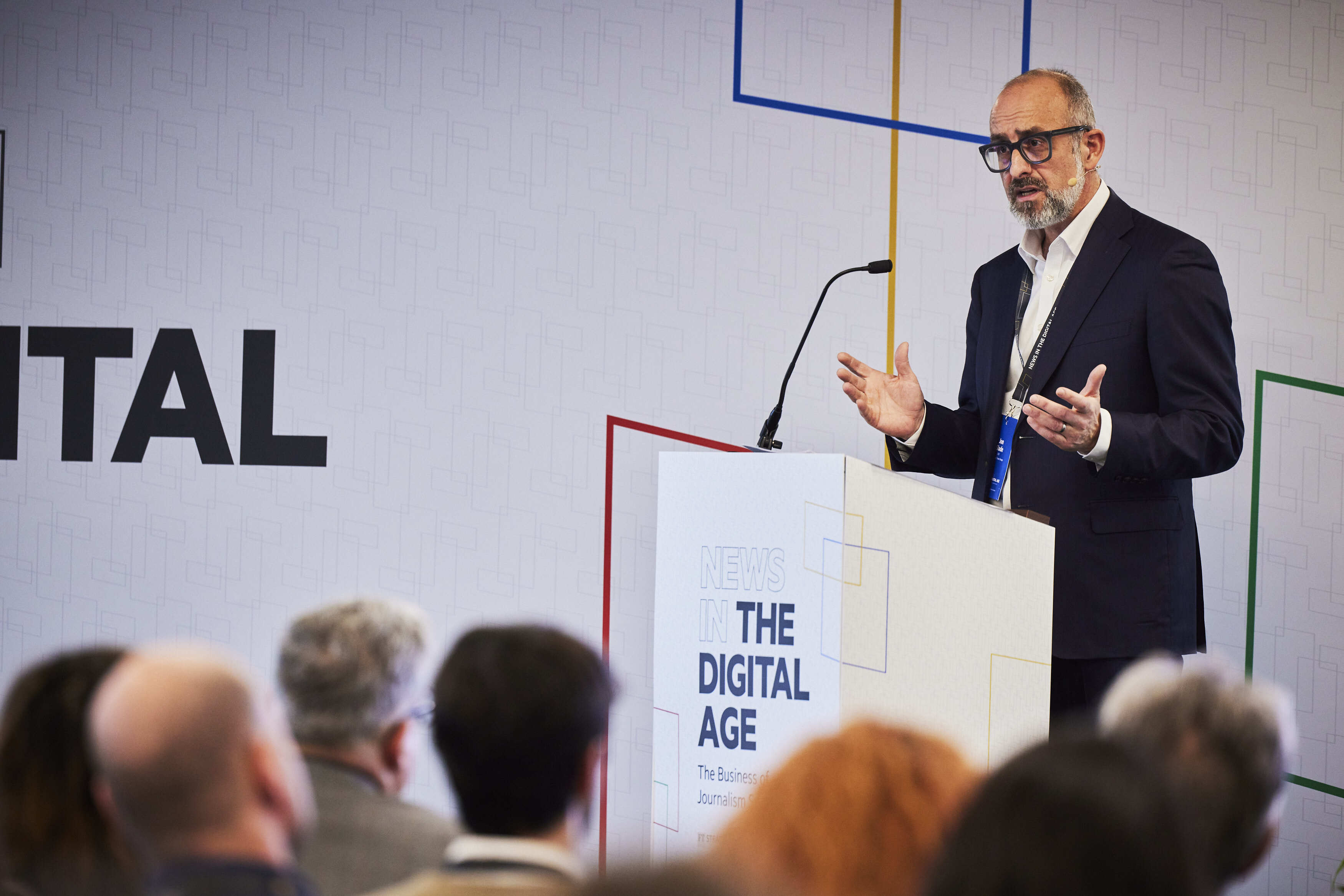
In his closing remarks at the News in the Digital Age event, Jon Slade, Chief Executive Officer of the Financial Times, framed the strategic challenge presented by generative AI in clear terms: in a world where content is abundant and intelligence increasingly cheap, human judgment becomes scarce —but also more valuable than ever.
We are publishing key passages from his speech as a provocation to the wider publishing industry and to technology companies whose platforms, products and partnerships increasingly shape how journalism is discovered, valued and monetised.
1. Human judgment as a strategic asset
Running through Slade’s speech is a clear thesis: in the age of generative AI, human judgement — rather than the ability to produce content — becomes a decisive asset for news publishers. He defines this as:
“Human judgment about what matters, what is true and about what is responsible to publish. Human judgment about what kind of news media ecosystem we choose to create.”
For media executives, institutional judgment becomes a source of competitive advantage. For technology leaders, it positions trusted, responsibly produced journalism as a critical input underpinning frontier AI models. This focus on high-quality journalism, Slade argues, is already reflected in emerging licensing deals and discussions around content marketplaces.
2. AI is a design choice, not destiny
Early on in his speech, Slade rejects technological determinism and frames AI as a governance question:
“Will we allow AI to strengthen or weaken judgment — and will it deepen or dilute trust as a result? That answer is not pre-written by technology.”
He reminds the audience that all technologies are shaped by people, whose “choices… determine how these technologies work in practice.” This is both a reminder to publishing executives that AI adoption must be deliberate, rather than reactive, and to technology leaders that they carry a significant responsibility when it comes to product development, user transparency and ecosystem partnerships.
3. AI is a design choice, not destiny
One of the most consequential ideas in Slade’s speech is that trust cannot be created or eroded in isolation. He points out that:
“Trust isn’t something any single newsroom can generate, defend, or sustain on its own. Trust is an ecosystem property. Even the most trusted publisher in the world operates inside a wider information environment — shaped by platforms, incentives, distribution systems, and now, by generative AI operating at unprecedented scale.”
The implication is that media organisations must engage with the wider ecosystem and understand the incentives and trade-offs when engaging with different companies and actors. More pointedly, technology platforms must be incentivised to make high-quality journalism “discoverable, distinguishable and rewarded” in such a way that a healthy information ecosystem can endure.
4. The economics of human judgement
It is at this point that Slade — who heads an organisation that employs 700 journalists across 40 countries and 2,900 people worldwide — makes an explicitly economic argument about the value of editorial responsibility:
“Content is abundant. Distribution is frictionless, and intelligence is increasingly cheap. But judgment — human judgment — remains costly. It is slow. It is trained. It is accountable. And it is inseparable from institutional responsibility.”
His point is that on-the-ground reporting, editorial oversight and institutional accountability require sustained investment. For news publishers, this necessitates durable and diversified revenue models capable of funding that work over time. But it also requires technology leaders to see high-quality journalism as a foundational input on which AI systems depend.
5. A system-level choice
Ultimately, Slade frames the AI transition as a structural choice about how journalism is treated and compensated:
“Do we build systems that treat journalism as raw material — something to be scraped, summarised, and recombined without responsibility? Or do we build systems that recognise journalism as the product of human judgment — something that carries cost, accountability, and value?”
This, he points out, is “not a technical choice” but “a moral, economic, and institutional one”. In doing so, he opens the door to the idea that both publishers and technology companies can both benefit: publishers can build viable, mission-driven businesses, while AI companies can create widely used and trusted products.
However, he is clear that partnership “must include a shared commitment to healthy information ecosystems” and “respect for editorial independence and processes, which includes taking accountability and liability for accuracy”. Without those principles, sustainable collaboration will prove difficult.
At FT Strategies, we work with media organisations to build strategies that protect editorial value while unlocking commercial growth in the AI era. From AI governance frameworks and licensing strategy to diversified revenue models and organisational transformation, we help publishers embed human judgment at the heart of sustainable, future-facing businesses.
If you’re navigating the strategic, economic or operational implications of generative AI, speak to our team to find out how to align innovation with trust — and build a model that rewards quality journalism in the long term.
%20(21)-1.png?width=768&name=Hero%20Image%20(website%20banner)%20(21)-1.png)
%20(54).png?width=768&name=Hero%20Image%20(website%20banner)%20(54).png)
%20(18).png?width=768&name=Hero%20Image%20(website%20banner)%20(18).png)