%20(56).png)
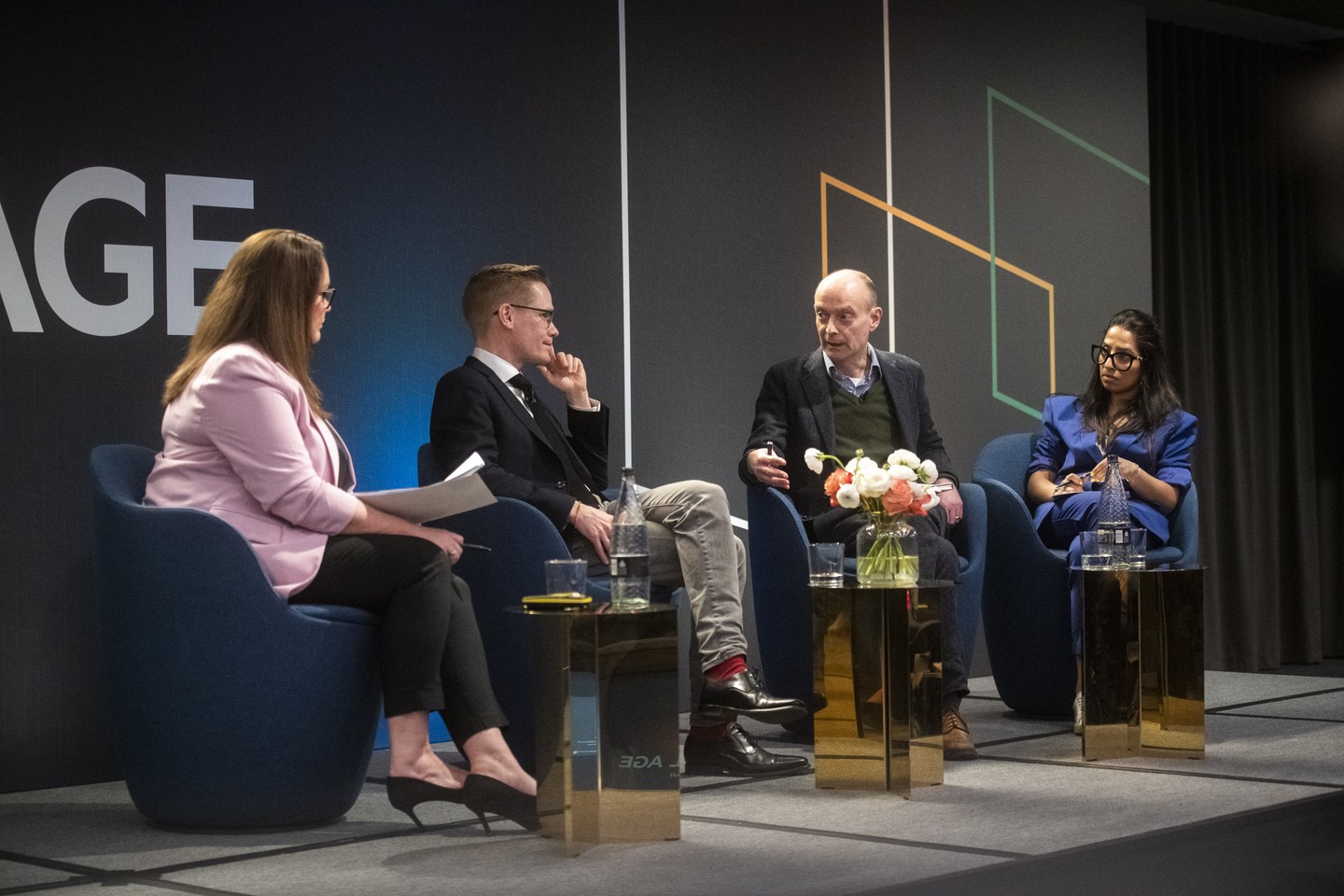

On Wednesday, 11th February, more than 290 leaders from across the global news ecosystem gathered in London for the latest News in the Digital Age, hosted by FT Strategies and the Google News Initiative.
This year’s theme — AI and the Business of Journalism — reflects a pivotal moment in the news and publishing industry. Across ten panel discussions, interactive presentations and keynote speeches, leading editors, media executives and industry experts examined how journalism can scale, adapt and grow in an increasingly AI-mediated ecosystem.
The event built on recent research conducted by FT Strategies: Next Gen News 2 and The Power of Registration, both in conjunction with the Google News Initiative, as well as foundational research into local news sustainability, supported by the Knight Foundation.
Below is a recap of the day’s sessions. Jump to specific panels to learn more:
Welcome and opening remarks
Sulina Connal (Managing Director of News & Books Partnerships, EMEA, Google) and Lisa MacLeod (Director, FT Strategies) kicked off the day by reminding attendees of the challenges and opportunities presented by the AI disruption. Sulina highlighted the “generational shift in user behaviour” that meant it was unsustainable for publishers to maintain the status quo. At the same time, Lisa noted the importance of FT Strategies’ partnership with the Google News Initiative, which has now supported more than 1,000 publishers worldwide, and shared examples of its own journey in supporting publishers with complex AI adoption projects.
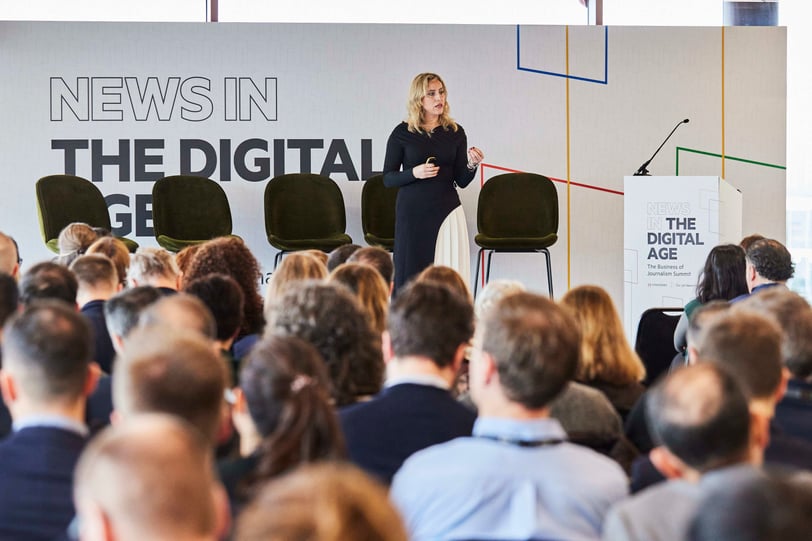
Ana Jakimovska, Head of AI Strategy at Mediahuis
AI and the business of journalism: The two paths to resilience
Ana Jakimovska (Head of AI Strategy, Mediahuis) examined the structural shifts reshaping the industry, including the decline in search referrals and the rise of zero-click environments and explained the knock-on effect on company, product and business transformation.
Key points included:
- AI is accelerating a split between “first-line news” and highly distinctive “signature journalism”, making the “traditional middle” harder to sustain. Ana explained how Mediahuis is experimenting with a giant database of sources and a series of AI agents to automate high-volume content that frees up editor capacity.
- Sustainable AI strategy requires organisational literacy, clear principles and protection of value. Mediahuis’ four-pillar AI framework — Foundations, Transform company, Transform product, Transform business — has helped provide clarity.
- Ana also highlighted the importance of collective publisher engagement to achieve fair value exchange with technology platforms.
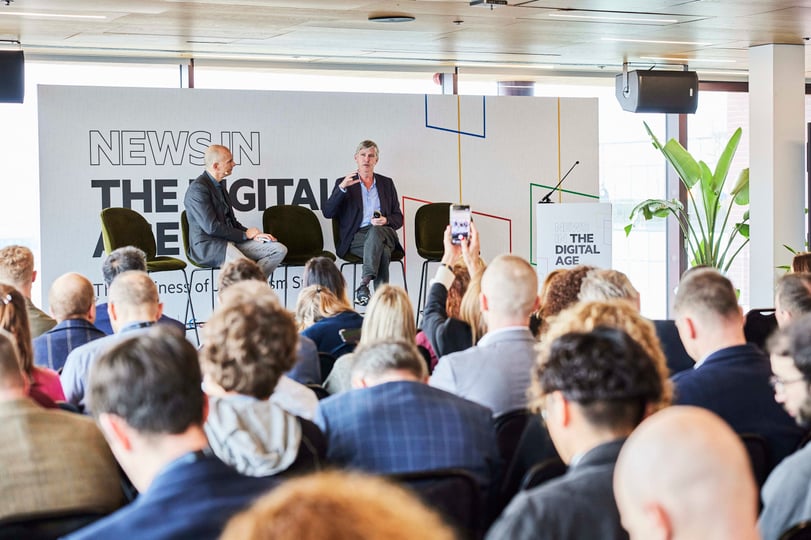
Steven Johnson, Co-Founder of NotebookLM and Tim Harford, Senior Columnist at Financial Times
Powering journalism through automation and NotebookLM
Steven Johnson (Co-Founder, NotebookLM) and Tim Harford (Senior Columnist, Financial Times) explored how AI systems grounded in trusted materials can support research, creativity and archive interrogation — and may be a win for news publishers creating distinct, original journalism.
They discussed how:
- AI can extend memory and enable semantic interrogation of vast personal or institutional archives. Steven has a collection of 8,000 quotes from books within NotebookLM that he searches for ideas and themes; each is linked back to the original source material for traceability.
- NotebookLM has opened up new ways of creating and consuming information; notes can be easily turned into podcasts or slide decks that are used in research, studying or publishing.
- There is a growing marketplace of bundles of content within NotebookLM’s platform, including from The Atlantic and The Economist. The company is looking into a subscription model to enable archive content to be monetised.
The state of the industry
Moderated by Arun Venkataraman (Global Lead for Emerging News Voices & Research, Google News Initiative), the panel examined shifting discovery patterns, audience expectations and trust dynamics. Social media is now the primary way many under-35s consume news and yet audiences report feeling overwhelmed by a noisy information ecosystem and seek journalism that offers clarity, empowerment and connection.
Other highlights from the panel included:
- Mitali Mukherjee (Director, Reuters Institute for the Study of Journalism) noted how The New York Times and other legacy brands have adapted to the rise of news creators by creating richer author pages on their websites and asking reporters to front videos about the type of journalism they care about and produce.
- Rozina Breen (Director of Editorial, Pulitzer Center on Crisis Reporting) reiterated the importance of holding power to account in an era in which political corruption is increasingly normalised. She called on journalists to think about how stories can create impact or lead to systems change.
- Picking up on a thread from the opening panel, Danuta Bregula (Managing Director, Onet, Ringer Axel Springer) predicted that news publishers will either “need to optimise for machines or direct relationships with humans. Everything in between will not exist”. She is increasingly hiring journalists who can tell stories across multiple platforms and formats to cater for the shift in user behaviour.
The evolution of the data-driven newsroom
Alan Smith (Head of Visual and Data Journalism, Financial Times) provided a brilliant case study about how AI has enhanced the FT’s ability to interrogate and present data in ways that inform readers and help them understand complex issues. He discussed:
- Computational journalism is particularly effective at surfacing patterns and “finding needles in haystacks” within large datasets. Alan shared how this was useful to spot relevant stories among the recently released Epstein files.
- Data journalism is evolving from “unicorn” capability — in which one person must know how to analyse, visualise and build data-led stories — into a cross-functional newsroom capability.
- Alan shared that the FT’s flagship visual journalism pieces, including a visual explainer on Saudi Arabia’s Neom Line, were produced by longstanding members of staff whose skills in print graphics have made them powerful digital storytellers.
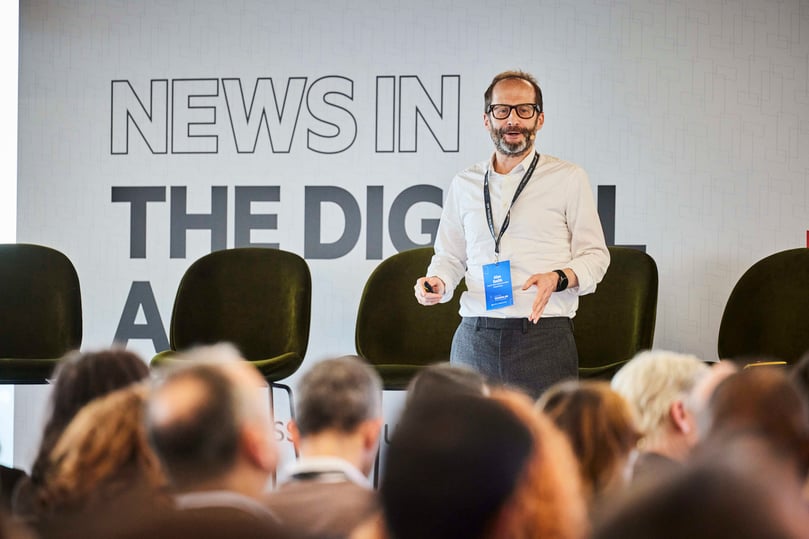
Alan Smith, Head of Visual and Data Journalism at Financial Times
What can news publishers learn from other industries?
Drawing lessons from adjacent sectors, the panel discussed AI’s impact on product development, provenance, explainability and monetisation. The discussion — moderated by Hayley Cochrane (Director of News Partnerships, UK & Northern Europe) — emphasised transparency, authenticity and responsible deployment as strategic decisions, not just technical ones. Highlights included:
- Fabien Lotz (Chief Operating Officer, Pops) explained how Pops has adopted AI tools across the board, particularly where “digital content can be translated across language barriers” and adapted into new formats, such as books, animations and cartoons.
- John Collomosse (Senior Principal Scientist, Research Manager, Adobe) highlighted the formation of the Coalition for Content Provenance and Authenticity (C2PA), which was formed to help provide producers with an audit trail from source to consumption and users with a level of trust in the content.
- Christine Foster (General Manager, AI and Automation, Experian) encouraged attendees to build on their organisation’s existing strengths and what’s already working as they develop processes to support key AI capabilities. For example, rolling out ways of working and processes that work in smaller teams and departments within organisations across the entire organisation.
Redefining storytelling: Al Jazeera’s AI-powered newsroom
Mohamed Moawad (Managing Editor, Al Jazeera) gave a powerful look at how one of the Middle East’s leading media brands moved from linear publishing to flow-based storytelling, prioritising how news travels rather than when it is “complete”.
Moawad also shared an experiment conducted through FT Strategies’ AI Launchpad programme in which Al Jazeera developed a solution to transform raw news into visually engaging stories in seconds, rather than hours. He believes “AI didn’t replace journalists, it protected their time”.
Putting readers first with AI at The National
In a fireside conversation, Mina Al-Oraibi (Editor-in-Chief, The National) and Lisa MacLeod (Director, FT Strategies) explored The National’s shift from print-first to reader-first and the role that registration and AI have played in connecting audience insight with newsroom decision-making.
They discussed how:
- Registration has been a way to synthesise all the information The National has on its readers and a crucial signal for journalists that their stories are having an impact. Since launching in 2024, The National has gathered more than 200,000 registered users. Registered users spend 4.5 times longer with The National than anonymous ones.
- The importance of carving out time for The National’s team to think about new tools and experimentation. Company town halls every six months provide a forum to discuss industry shifts and gauge staff views. Mina said she felt “it’s unreasonable to [ask the team] follow the news cycle and then figure out how to innovate on top of that”.
Mina Al-Oraibi, Editor-in-Chief at The National
Scale without sacrifice: Moving beyond AI experiments
Alexander Varov (CEO, NetInfo) and Nadya Gancheva (CCO, NetInfo) presented their work addressing real-life bottlenecks and production pain points within the NetInfo newsroom. Similar to Mediahuis, the Bulgarian publisher has experimented with reducing the amount of time spent producing day-to-day articles and allowing journalists and editors to work on in-depth stories with impact. The team succeeded in reducing the amount of time a rewrite took by 30%.
Alexander and Nadya also highlighted the importance of their participation in the FT Strategies’ AI Launchpad programme, which allowed them to scale initial small experiments and create real value for the newsroom.
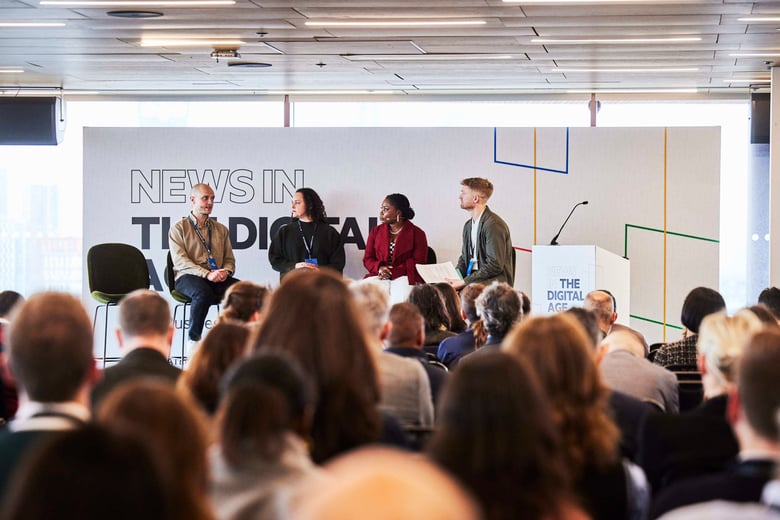 Jack Davenport, Co-Founder at Goalhanger, Lauren Saks, Co-Founder of Local News International, Oluwadunsin Sanya, Head of Editorial & Innovation at BellaNaija and Aled John, Group Strategy Director at Financial Times
Emerging news voices
This panel looked at how creator-led and digital-native models are reshaping distribution, monetisation and audience relationships and what traditional news publishers can learn. Drawing on Next Gen News 2 research, the panellists, led by Aled John (Group Strategy Director; Financial Times), shared their experiences:
- Oluwadunsin Sanya (Head of Editorial & Innovation, BellaNaija) has grown BellaNaija to 10 million followers across platforms since it was founded 20 years ago as a blog. It has had success by taking a solutions-focused approach to stories; for example, it focused on ways to support families affected by severe flooding.
- Jack Davenport (Co-Founder, Goalhanger) explained how Goalhanger has scaled to 75 million monthly downloads by being rigorous with its development cycles and focusing on creating a vibrant relationship between co-hosts. This involves targeting key talent they want to work with (“the perfect mix is two people who don’t know each other that well but respect one another… It doesn’t work if it's two best friends”) and spending a lot of time in the studio creating mock podcasts that help to develop chemistry between the hosts.
- Lauren Saks (Co-Founder, Local News International) called out the time it takes to build an engaged audience, which is often longer than traditional news publishers allow for. She advocated “giving your talent space to make mistakes and grow” because success does not come overnight. Lauren also spoke about the importance of business development support for ‘new format’ teams; a practice that traditional news publishers often neglect, as they often only focus on reach. That includes things like helping teams launch merch, attracting new types of advertisers, or even launching different subscription offerings for audiences originating from social.
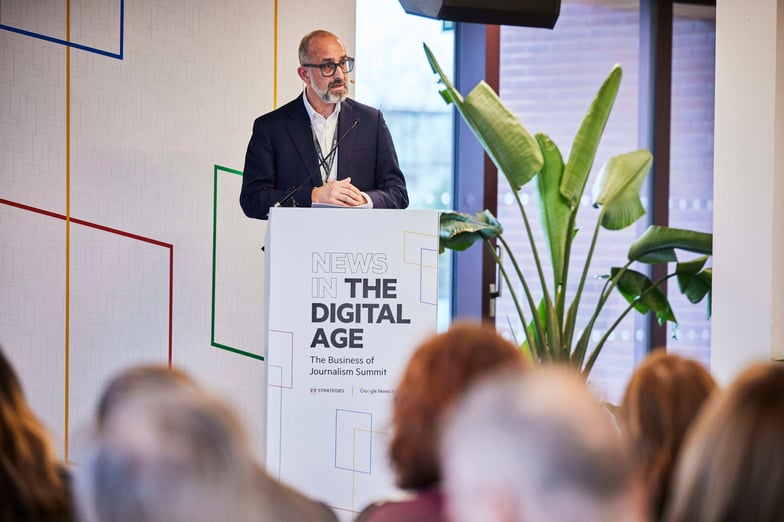
Jon Slade, Chief Executive Officer of the Financial Times Group
What makes it ‘journalism’?
In the closing session, Jon Slade (Chief Executive Officer, Financial Times) helpfully reframed the AI debate through the lens of human judgment.
While AI naturally introduces potential for efficiencies and new formats, Slade explained that journalism’s enduring differentiator will always be accountability, editorial standards and trust.
He explained that “AI must serve journalism, not the other way around” and reiterated that there are things journalism can do which AI can’t, including cultivating sources and earning people’s trust.
If your organisation is navigating AI implementation, registration strategy, newsroom redesign or commercial transformation, FT Strategies is ready to support you. Get in touch with our expert team to explore how we can help build a sustainable, trusted future for your newsroom.
%20(24)-2.png?width=768&name=Hero%20Image%20(website%20banner)%20(24)-2.png)
%20(20)-1.png?width=768&name=Hero%20Image%20(website%20banner)%20(20)-1.png)
%20(21)-1.png?width=768&name=Hero%20Image%20(website%20banner)%20(21)-1.png)