
This article is part of the Next Gen News(room) series from FT Strategies. In this series, we translate emerging research on shifting news consumption behaviours into practical newsroom strategy. Drawing on insights from Next Gen News 2, produced in collaboration with the Knight Lab at Northwestern University’s Medill School of Journalism, we explore how publishers can redesign strategy, workflows and transparency to reflect how audiences engage with news today — and how to operationalise those insights across the organisation.
Many newsrooms spend significant time curating their homepage, showcasing their most important or distinctive stories and signalling editorial priorities through page hierarchy and presentation. However, to many audiences, not only younger ones, this effort goes unnoticed.
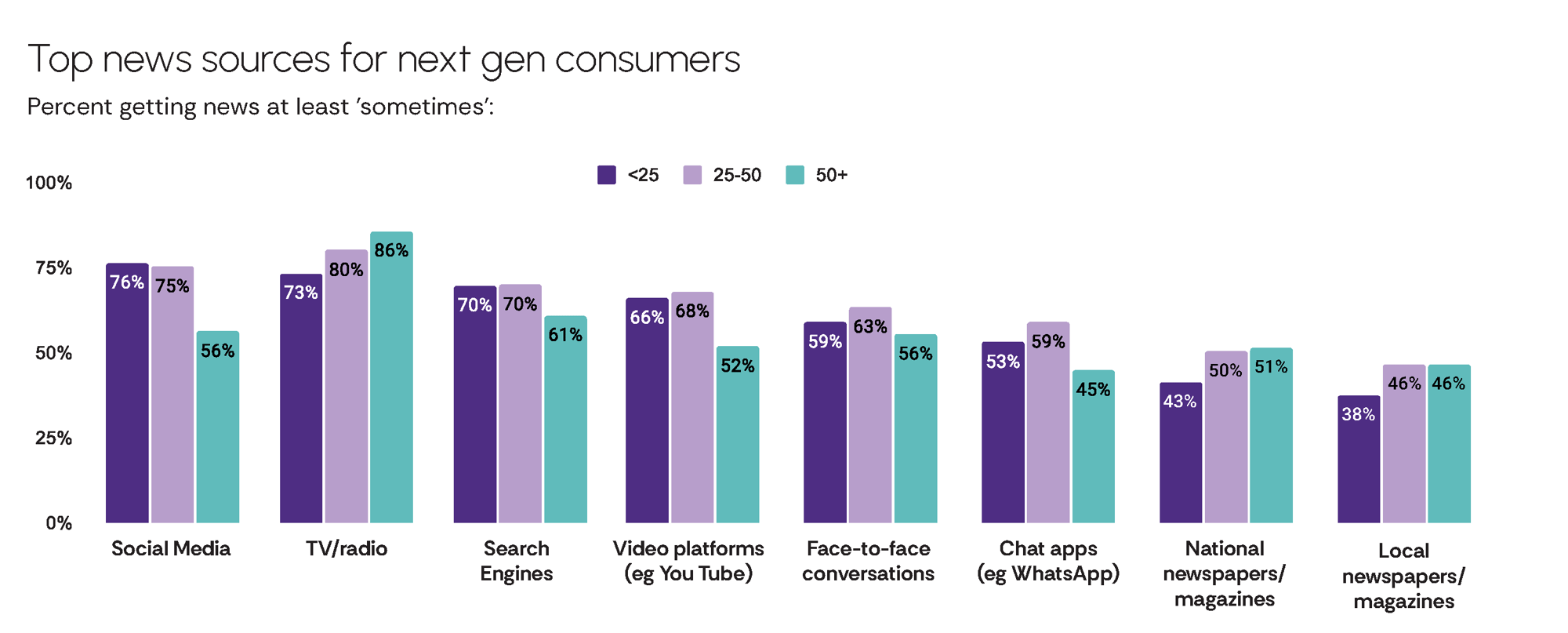
As the 2025 Digital News Report noted, more news consumers are using social media as their main source of news at the expense of traditional channels such as websites and TV news. That’s even the case among 35-44 year olds, a segment you might expect to have developed a stronger habit of going directly to publisher-owned destinations.
The recently published Next Gen News 2 report saw this shift even more starkly; 76% of Gen Z and 75% of middle-aged research participants now use social media as their primary source of news.
With news becoming more platform-driven, the question becomes: how can publishers meet these audiences off-platform before driving them to their website and apps? We believe the answer lies in reforming content distribution — that is, understanding the inner workings of each platform and creating tailored content.
Some traditional news publishers, including The Washington Post, The Guardian and Morning Brew, have adapted their content creation processes to account for this news audience behaviour. But independent news creators have done even more to shape consumer expectations, structuring their journalism around the platform in a way that differs from the majority of legacy news producers.
“Don’t try and shoehorn your existing content onto social media for clicks and to just be efficient. You need to craft your content for social media first.”
- Lisa Remillard, The News Girl
This presents publishers with an operational challenge: How can they learn from independent news creators and become a distributionally-focused organisation?
Reversing the Journalism Process
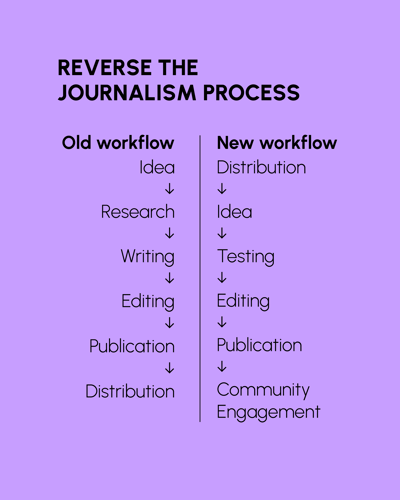
In many traditional newsrooms, content is commissioned in a largely linear way: the story is decided first, then written, edited, published and finally adapted for distribution. This approach assumes that if the journalism is strong enough, audiences will find it.
However, increasingly, that is no longer the case. In feed-based environments, the way a story is packaged, formatted and delivered plays a major role in whether it is encountered at all.
That has led emerging news producers to reverse that workflow. Rather than starting with the story alone, they increasingly make decisions about channel, format and audience context before — or alongside — deciding what to cover.
Over time, they become deeply familiar with the formats and platforms they publish to, testing what works and refining it into repeatable templates. The result is a more deliberate relationship between journalism and distribution.
Case Study
One creator who does this particularly well is Dave Jorgenson from Local News International. Jorgenson first built audience interest and trust through comedy skits under the Washington Post brand before expanding into news. His use of humorous characters and an approachable tone is designed to resonate with audiences on video platforms such as YouTube and Instagram.
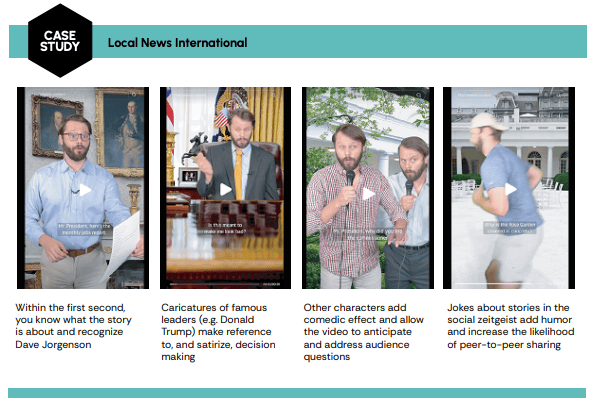
To identify stories worth reporting, Jorgenson and his team begin by reviewing the top stories and assessing whether they offer a unique perspective. If they can make a story approachable, interesting, or humorous, they cover it; if not, they don’t — even if it’s a main headline.
Jorgenson also understands that not all stories are right for every platform. On TikTok, Instagram, and YouTube Shorts, content that evokes emotions and human narrative works best, whereas YouTube is preferred for more complex stories, given its longer format.
By adopting these best practices, publishers build engaged audiences that become website and app subscribers.
The Opportunity
If more audiences now encounter journalism through feeds, search results, video platforms and messaging apps, then discovery can no longer be treated as a downstream marketing concern. It has to become part of the editorial operating model.
A discovery-first approach creates an opportunity to meet audiences where they already are, build stronger top-of-funnel awareness and make it easier for journalism to travel across networks. It also creates a clearer path from off-platform reach to on-platform value — whether that is app usage, newsletter sign-up, registration or subscription.
However, centering discovering in newsrooms raises a series of questions for various teams across the company:
1. Strategy: What new tools and technologies are needed to enhance production and distribution?
For many publishers, discovery still sits awkwardly between editorial, audience and product teams. A discovery-first newsroom requires a more explicit set of organisational capabilities. That may mean prioritising investment in:
- Video, audio and visual storytelling formats that travel well off-platform
- Platform expertise that helps teams understand how discovery actually works in different environments
- Product features that make it easier for audiences to move from rented platforms to owned ones
- Data and testing capabilities that support faster learning about packaging, timing and format
The key is not to build everything at once, or to over-invest in a single platform. It is to identify the capabilities that support distribution across multiple environments and align them with your wider growth model.
2. Content production: How can current employees be deployed most effectively? What does the new workflow mean for the overall hiring structure?
A discovery-first workflow changes what happens at the point of commissioning. Instead of starting solely with the editorial merit of a story, teams also need to ask:
- Where is this story most likely to be encountered?
- What format will make it legible in that environment?
- What is the strongest hook, visual or structure for that platform?
- What evidence do we have that this topic or treatment will resonate?
This does not mean abandoning editorial judgement in favour of trend-chasing. It means combining editorial judgement with a clearer understanding of how stories travel. We believe it is possible to do both simultaneously.
In practice, this often requires closer collaboration between reporters, editors, audience teams and analysts from the outset rather than relying on downstream repackaging once the story is complete.
3. Distribution: How can content be produced to reach the widest possible audience?
A discovery-first approach requires publishers to think less in terms of “keeping feeds updated with content” and more in terms of platform roles. The most successful publishers, both traditional and emerging, utilise platforms in different ways to support their goals:
- On interest-graph platforms (e.g. TikTok), the focus is often on attention and first encounter
- On social-graph platforms (e.g. Facebook), the emphasis is more on repeat exposure and community
- On owned platforms (e.g. newsletters, push notifications), the goal is depth, retention and conversion
This makes platform fluency a newsroom-wide capability rather than the sole responsibility of a central social team. In practice, it often means:
- Moving towards deeper channel-specific expertise rather than one generalist team doing everything
- Creating clearer collaboration between editorial, audience, video and engagement teams
Investing in low-friction sharing and recirculation tools that help content travel more effectively
The takeaway is this: becoming discovery-first is not just about doing more on social. It is about adjusting structure, workflow and capability to reflect how audiences now find journalism.
Where to start
If you’re looking for three practical steps to begin experimenting with modes without restructuring your newsrooms, consider the following:
1. Focus on 1-2 capabilities for growth
Rather than launching new activity across every platform, begin by reviewing the past month of content to identify what is already working. Look for patterns in format, packaging, topic and platform performance.
Then conduct a competitor analysis to understand where your current approach is strong, where it is weak and what may be missing from your distribution strategy. From there, identify one or two discovery capabilities to prioritise — for example, journalist-led short-form video, push notifications, live coverage or creator collaborations.
2. Build cross-functional teams
Many newsrooms are still organised in a way that separates editorial creation from audience distribution. A discovery-first model works best when those functions are brought closer together.
As a first step, bring the key actors in the journalism process — editors, reporters, audience specialists, analysts, video producers and product teams — into the same planning conversations. Encourage experimentation towards clearly defined goals (e.g. increasing the brand’s following on by x%) and be mindful of giving distribution specialists enough influence at the point of commissioning.
3. Build platform fluency across the newsroom
The most effective emerging news producers succeed because they are also heavy consumers of the platforms they publish to. They understand the pacing, tone, visual language and audience expectations of each environment because they spend time in them.
For publishers, that means creating deliberate opportunities for newsroom staff to build that same fluency. In practice, this could include:
- Informal staff training or all-hands on platform conventions
- A ‘what’s worked’ internal industry newsletter or Slack update to highlight competitor best pratices
- Platform-by-platform playbooks to help staff extend their reach and engagement off-platform
If you are reassessing whether your current operating model reflects distributed consumption, we work with publishers to:
- Identify gaps in discovery capability and content performance
- Redesign workflows to support platform-native storytelling
- Align teams, metrics and product priorities around stronger off-platform growth

.png?width=768&name=NGN%202%20%20Blog%203%20(1).png)
%20(24)-2.png?width=768&name=Hero%20Image%20(website%20banner)%20(24)-2.png)