
This article is part of the Next Gen News(room) series from FT Strategies. In this series, we translate emerging research on shifting news consumption behaviours into practical newsroom strategy. Drawing on insights from Next Gen News 2, produced in collaboration with the Knight Lab at Northwestern University’s Medill School of Journalism, we explore how publishers can redesign strategy, workflows and transparency to reflect how audiences engage with news today — and how to operationalise those insights across the organisation.
News publishers will often ask how to grow their younger audiences or, if they’re being specific, how they can attract more Gen Z users. The assumption behind the question is usually the same: that younger audiences are disengaged from news and need to be “won over” with specific coverage of specific topics or content formats.
Next Gen News 2 found that isn’t necessarily the case. Across the five markets that we conducted the research, 55% of under-25s consume news daily. We also found that the proportion of people actively trying to avoid the news is between 25% and 47% across Brazil, India, Nigeria, the UK and the US — less than might be expected if you have been tracking the rise of news avoidance.
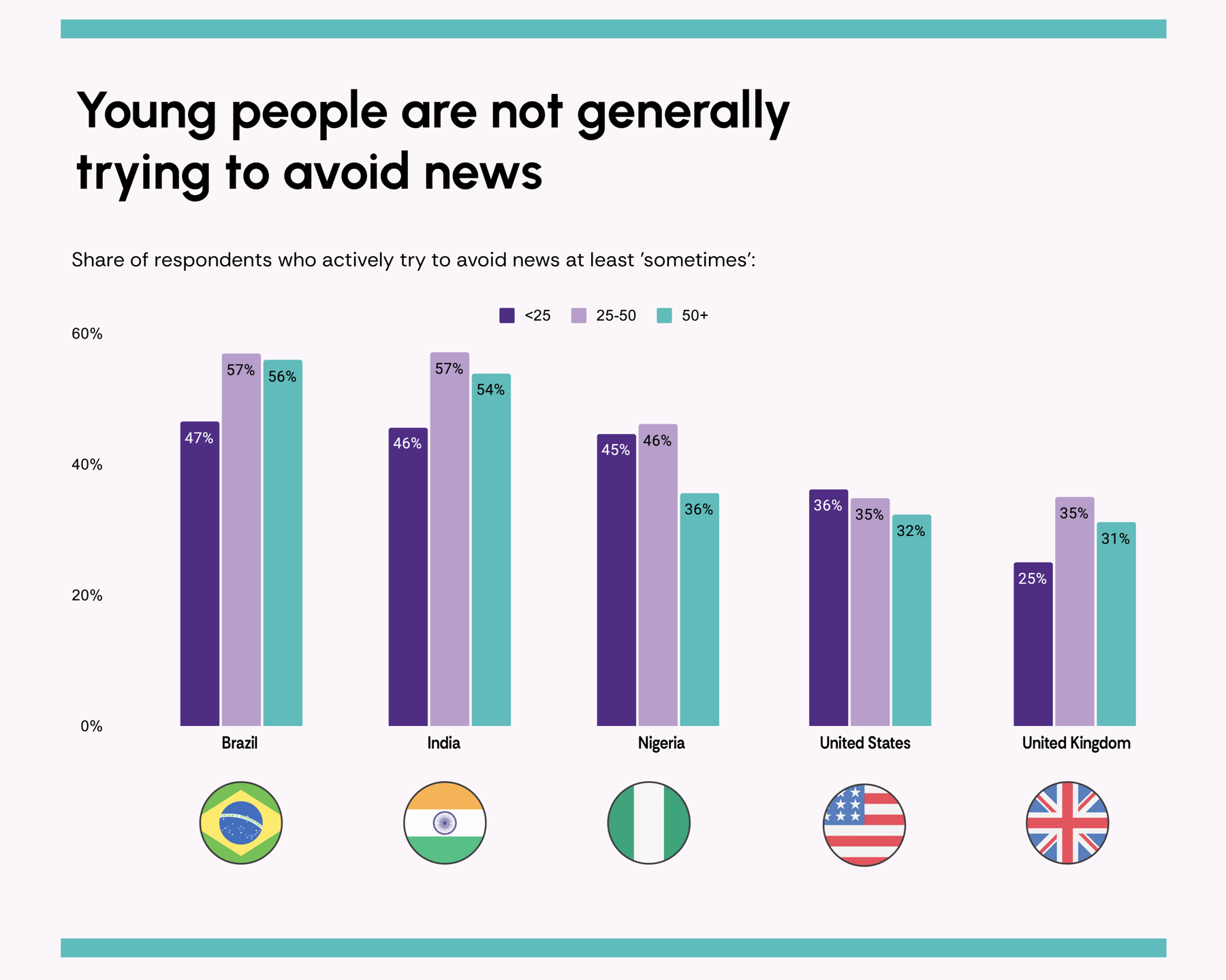
As such, we concluded that younger audiences are not completely disengaged from news but they are navigating an information environment defined by the abundance of news, blending of news with entertainment and the fragmentation of news providers.
“I think for me the biggest challenge to stay informed is just the amount of media that I can consume and can find in different channels. It’s hard to sort them out and to understand what to pay attention to and what to not… just because there’s so much available on the platforms.”
- Medina B, UK
And it’s not just under-25s. Our survey of 5,000 respondents aged 18 and above found that older audiences report being put off by the news at similar rates to younger ones. We also found that people aged 25–50 use social media and video platforms for news almost as much as younger respondents. Taken together, these findings suggest that news consumption behaviours are often shared across demographic groups, rather than being defined by age alone.
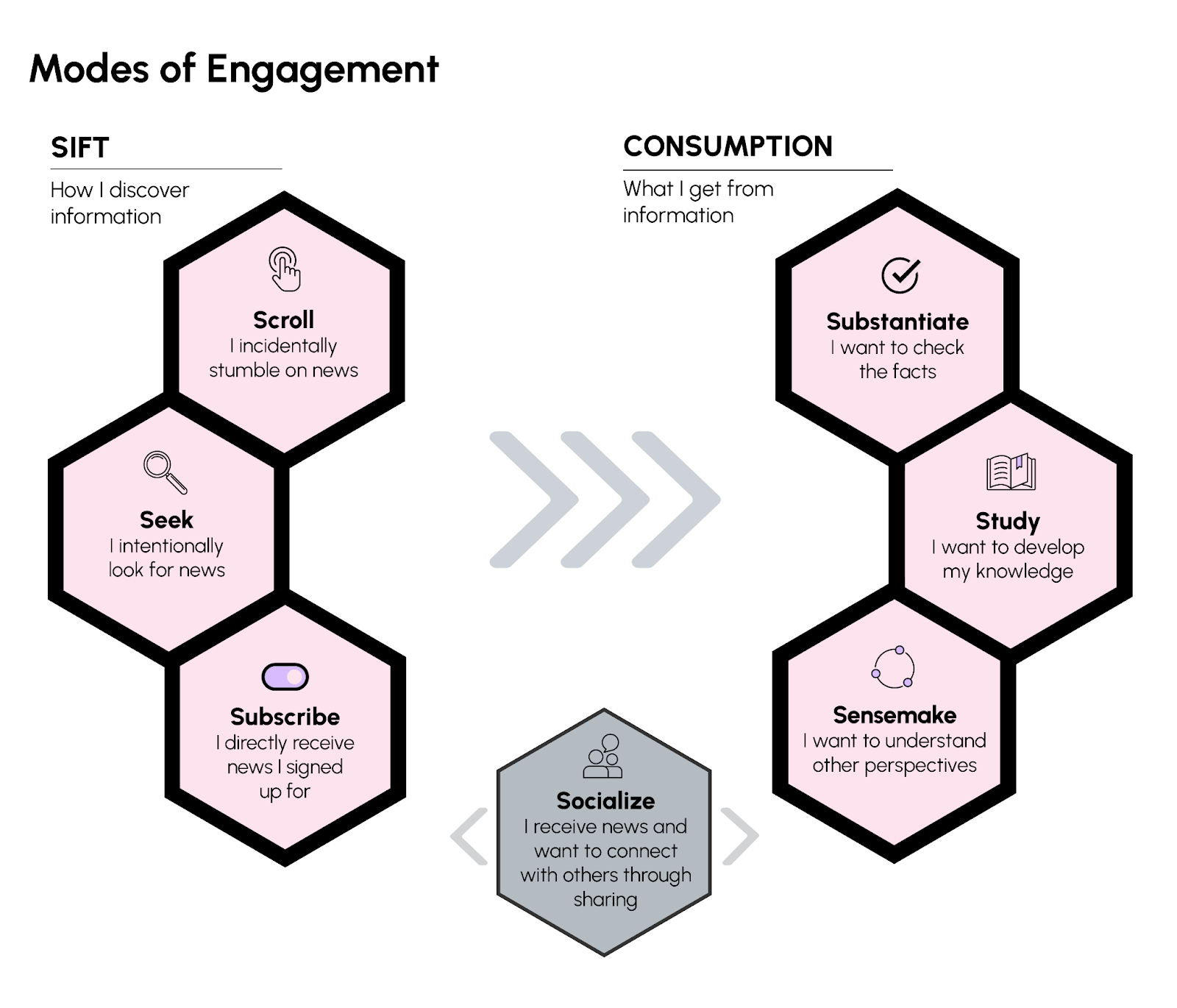
That’s where the Modes of Engagement framework comes in. Evolved from our initial research, the framework reflects not only how next gen consumers discover and engage with news but increasingly how most news consumers do so — without intent, weighted depending on who they receive it from and consumed in a myriad of ways.
With that in mind, the question is no longer “How do we reach Gen Z?” but “Which modes do we cater for— and which are we failing to deliver?”
Case Study
Independent journalist and filmmaker James Li has a distinct visual identity that allows users on TikTok to quickly identify him in their feeds — in what we call the Scroll mode.

- Unique identity: his distinct bucket hat — used in all videos — allows him to be spotted quickly while users are scrolling through their feeds.
- Visual hooks or imagery: open-ended questions — usually written in large white text on a red background — capture the audience’s attention and quickly make it clear what topic the video is about.
Using images of well-known individuals and adopting a signature opening line are other ways that news creators help users quickly find content in the Scroll mode of engagement. But these tactics — like many we document in the research — are not explicitly targeted towards young people; they are designed for specific engagement states across all age groups.
The Opportunity
As younger and older readers alike face similar challenges when navigating the current information environment, we believe there is an opportunity to align with how most audiences encounter and consume news. Modes of Engagement is a way of attracting younger consumers without alienating traditional or older readers.
However, bringing Modes into your operating model raises important questions for news publishers’ strategy, content production and distribution, which we’ve set out below:
1. Strategy: what does it mean to move from target segments to Modes of Engagement?
Most news publishers are already stronger in particular modes; some excel in producing authoritative fact checks that allow readers to Substantiate while others offer a wide range of perspectives around a single topic to help audiences Sensemake. Not every publisher can or should seek to win every mode.
Defining your organisation’s mode priorities and then aligning resources and investment to these areas will increase the likelihood of becoming the default destination for a specific engagement state, rather than simply competing for younger consumers’ attention.
2. Content production: which Mode of Engagement is your content designed to address?
Mode-thinking forces a sharper focus at the point of commissioning and a clearer set of criteria for stories. For example:
- If it’s Scroll, it needs a clear hook, native packaging and a strong dose of emotional resonance.
- If it’s Substantiate, it must lead with facts and visibly show sources that it has drawn on.
- If it’s Study, it needs a clearly signposted learning objective and a coherent, well-paced structure to get consumers through to the end.
We believe this tailored approach has the additional benefit of protecting editorial standards by allowing teams to adapt a story’s format and presentation without oversimplifying the details. The story is intentionally designed for how audiences engage with it, rather than being defined by its format (e.g. ‘let’s produce a video on…’).
3. Distribution: how does mode-thinking reshape the way content travels?
For many audiences, distribution is the entry point to engagement; Scroll, Seek and Subscribe modes, in particular, are shaped by off-platform features and behaviours. This makes platform fluency a newsroom-wide capability and not just the responsibility of the central social or audience team.
In practice, this requires a shift in how teams are structured:
- Move towards deep channel-specific speciality (e.g. TikTok lead) rather than one centralised social team that does everything.
- Ensure close collaboration between editorial, social/audience teams, video, and engagement functions (e.g. newsletter or push notifications) by creating shared metrics/goals that incentivise working together.
- Invest in methods of audience-driven content discovery (e.g. frictionless article sharing via the website and app) that allow journalism to travel easily across platforms and social networks.
The takeaway here is this: designing for modes is not only relevant for teams tasked with managing distribution channels. The real opportunity is in adjusting a newsroom’s structure and operations to better reflect how audiences experience journalism.
Where to start
If you’re looking for three practical steps to begin experimenting with modes without restructuring your newsrooms, consider the following:
1. Run a mode audit across your output
Review the last 2-4 weeks of content and map it against the seven Modes of Engagement to understand how much content sits in each bucket, which content performs best for your goals (e.g. scale vs engagement) and whether you’re underproducing particular modes.
This exercise can often explain why digital KPIs are lagging where they should be; most publishers tend to underindex modes that drive discovery and habit. AI can be used to speed up this auditing process; read our advice about running a content audit.
2. Build mode KPIs into your ‘metrics that matter’ framework
Most publishers already have a defined set of ‘metrics that matter’ which are used to guide teams and align activity with broader business goals. If you’ve decided to prioritise a particular Mode of Engagement, those priorities should be reflected explicitly within that framework.
For example, if the ambition is to strengthen the Study mode, depth-based metrics — such as article or video completion, return visits and time spent consuming series content — should carry greater weight than top-line reach metrics.
3. Pilot a ‘mode first’ commissioning process
Including ‘mode’ in your commissioning schedule or plan forces editorial staff to think about how audiences encounter and engage with content, rather than simply starting with the format (e.g article, video).
We recommend rolling out ‘mode first’ commissioning with one department of your newsroom or on a time-bound news event (e.g. coverage of a sporting event) to allow analysis about what has worked and what hasn’t.
If you are reassessing whether your current operating model reflects behavioural reality, we work with publishers to:
- Conduct content audits and identify structural gaps
- Redesign workflows around priority engagement states
- Align KPIs, teams and product investment to support long-term growth

.png?width=768&name=NGN%202%20%20Blog%203%20(1).png)
%20(24)-2.png?width=768&name=Hero%20Image%20(website%20banner)%20(24)-2.png)