.png)
This article is part of the Next Gen News(room) series from FT Strategies. In this series, we translate emerging research on shifting news consumption behaviours into practical newsroom strategy. Drawing on insights from Next Gen News 2, produced in collaboration with the Knight Lab at Northwestern University’s Medill School of Journalism, we explore how publishers can redesign strategy, workflows and transparency to reflect how audiences engage with news today — and how to operationalise those insights across the organisation.
Brand reputation still matters.
That’s what we found during our Next Gen News 2 research, where traditional news producers remain among the most trusted sources in many markets. For many under-25s, legacy brands are still the place to verify whether information is “true”. A mixture of institutional credibility and familial loyalty towards particular news outlets continues to carry weight — even when consumption has shifted away from newspapers or TV channels and towards social and video platforms.
“I think I got to know about AajTak from [the] television channel only. My family watches it every morning so I followed it on Instagram as I’m not watching television much.”
- Anya K, India
However, the research also found that a publisher’s reputation alone is not sufficient. Audiences are navigating a fragmented, overwhelming information environment in which brand perception can shift quickly. Research participants frequently raised concerns about:
- News based on non-factual or unsubstantiated information, particularly with the growing prevalence of generative AI.
- Sensationalised stories and the use of emotive language to drive audience engagement or “clicks”.
- Interpretations of news events that are skewed by a publisher’s implicit values or political and financial motives that audiences aren’t aware of.
Our original Next Gen News research identified three sub-factors that shape how audiences do this:
This results in a scenario where nothing is taken at face value. Instead, younger consumers reported wanting to verify whether something is factual and accurate but also fairly framed and complete.
- Credibility – Does this source know what it is talking about?
- Affinity – Do I feel connected to this person or brand?
- Transparency of intention – Do I understand their motives and perspective?
Traditional publishers often score highly on credibility. But transparency of intention — explaining why a story is covered, how it was reported and what may remain uncertain — is increasingly important and frequently underserved.
This is particularly the case in the Mode of Engagement we call Substantiate. In this mode, users seek to verify a piece of information through trusted sources in a self-directed way that preserves their sense of agency. Examples include verifying headlines with trusted sources, searching to see if multiple sources reported similarly and reading comments for fact-checking or shared suspicion.
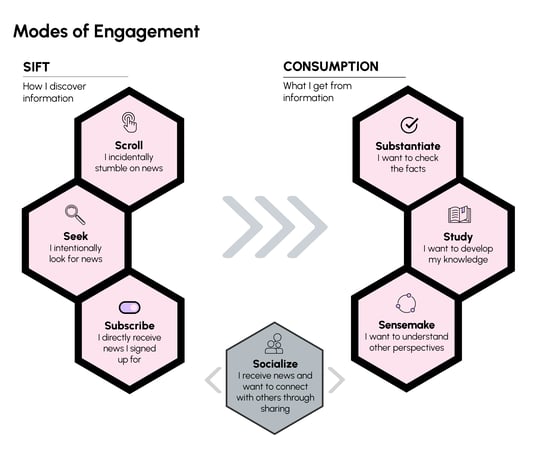
This type of behaviour is a direct response to information overload and subsequent distrust and presents a critical opportunity to design transparency into their product experience.
Case Study
-1.png?width=1920&height=1080&name=Untitled%20design%20(1)-1.png) Brazilian fact-checking organisation Aos Fatos publishes all of the sources it uses to substantiate claims and provides an overview of how investigations are conducted, including the techniques and tools used. It explicitly highlights where information is evolving or incomplete, which serves to strengthen its credibility among readers.
Brazilian fact-checking organisation Aos Fatos publishes all of the sources it uses to substantiate claims and provides an overview of how investigations are conducted, including the techniques and tools used. It explicitly highlights where information is evolving or incomplete, which serves to strengthen its credibility among readers.
Aos Fatos has also built FátimaGPT, a chatbot integrated into WhatsApp, Telegram and the web, that allows users to fact-check claims directly. The bot pulls from the organisation’s archive and provides cited responses that expressly cater to the Substantiate behaviour found in the Next Gen News 2 research.
The Opportunity
We believe that showcasing institutional judgment in this way can become a source of competitive advantage for news publishers. As Jon Slade, the chief executive officer of the Financial Times, recently noted:
“Content is abundant. Distribution is frictionless, and intelligence is increasingly cheap. But judgement — human judgement — remains costly. It is slow. It is trained. It is accountable. And it is inseparable from institutional responsibility.”
In this context, showing the decision-making process moves from a ‘nice to have’ to a strategic differentiator — and to be reinforced by editorial and marketing functions:
1. Strategy: How are we operationalising trust beyond brand reputation?
For some news publishers, there is an opportunity to put trust at the core of their mission and to articulate a vision that achieves commercial success without compromising quality and integrity. This requires centring trust as part of the core value proposition — which the FT has done — in a way that goes beyond marketing or brand positioning to include:
- How success is defined internally - incorporating metrics such as the Reuters Institute of Journalism Digital News report or Edelman Trust Barometer alongside existing commercial KPIs.
- How products are prioritised and designed - building features that enable greater connection with editors and journalists (e.g. commenting, Q&As and livestreams) and experimenting to make story selection and prioritisation more visible.
- How generative AI is deployed responsibly - establishing clear guardrails around AI-assisted reporting, disclosing where automation is used and the rationale for this approach.
Publishers that do this consistently well stand to be better positioned to build long-term loyalty, justify premium pricing and withstand shifts in platform dynamics.
2. Content production: How visible is our editorial judgement within the story itself?
Editorially, there is significant scope to make institutional judgement more explicit without compromising standards or authority. For example:
- Clear labelling of news, analysis and opinion on homepage and article pages, reducing ambiguity about format and intent.
- Making the sources in an article — individuals and institutions — more easily navigable and searchable, so audiences can explore provenance.
- Sharing the personal experience and expertise of journalists and editors involved in a story, reinforcing that reporting is conducted by trained professionals with subject knowledge and accountability.
- Explicitly recognising potential conflicts of interest, particularly when reporting on companies with ownership or commercial links to the brand.
Together, these steps move transparency from a value to a visible output and reinforce the idea that quality journalism is the result of deliberate human judgement.
3. Distribution: Do our credibility signals travel with our content?
While more challenging to achieve in the, ensuring that credibility travels off-platform is increasingly critical. Next Gen News 2 found that a significant proportion of news consumption now takes place in distributed environments — social platforms, messaging apps and aggregators — where publisher brands and context are often stripped away, making it harder for audiences to identify the source and assess credibility.
Best practice here includes:
- Watermarking or clear labelling of visual content with the source and brand to protect attribution and reinforce brand recall.
- Prompts to get readers to read the full article before sharing in order to reduce misinterpretation and drive brand loyalty and engagement.
- Active media monitoring and brand protection strategies that mitigate brand impersonation or the misuse of its content.
Where to start
If you are looking to embed transparency more deeply into your newsroom operations, consider three practical starting points:
1. Publish your methodology for major investigations and series.
For high-impact reporting — such as investigations, data projects or long-running series — consider publishing a short methodology that explains how the reporting was conducted. This might include:
- Why the story was prioritised
- How information was gathered
- What evidence was verified
- Where limitations or uncertainties remain.
Making the reporting process visible can also act as a differentiator when other outlets report on the stories or when the findings circulate across social platforms and aggregators in ways that strip away context.
2. Redesign article templates with transparency in mind.
Many signals that indicate quality reporting — sources, data, methodology and editorial oversight — are currently buried within articles or omitted entirely from page templates. Redesigning article pages to surface these signals more clearly can help readers quickly assess how a story was produced.
This might include dedicated “Sources cited” or “How we reported this” sections, expandable annotations explaining evidence, or links to primary documents and datasets. Testing these elements with audiences can reveal whether they improve comprehension and confidence, particularly among readers who encounter the content via social platforms or search rather than through the homepage.
3. Create an internal transparency checklist for editors.
One practical approach for embedding transparency is to introduce a short transparency checklist that editors use before publication. This could include prompts such as:
- Is the central claim clearly stated and supported by evidence?
- Are sources and methodologies visible to readers?
- Have uncertainties, limitations or competing interpretations been acknowledged?
- Could the story be misinterpreted if it is encountered out of context on social platforms?
Over time, integrating these questions into editorial routines helps build a culture where transparency is treated as a core element of reporting quality rather than an optional add-on.
If you are reassessing how your organisation demonstrates credibility in an AI-accelerated, low-trust environment, we work with publishers to:
- Audit how trust signals appear across content, product and distribution
- Embed transparency into editorial workflows and governance structures
- Design product features that make verification visible and frictionless
- Align KPIs and investment decisions with long-term audience confidence


%20(24)-2.png?width=768&name=Hero%20Image%20(website%20banner)%20(24)-2.png)