
This article is Part 1 of a two-part series on how media organisations can redesign their operating models to deliver sustainable growth through organisational alignment. You can read Part 2 here.
A blueprint for successful transformation
Imagine trying to redesign your house based on a new vision of how you want it to look. You begin knocking through walls, adding new rooms and swapping out the furniture to match the direction you’ve chosen. There’s just one problem: you didn’t assess the structural layout of the house first to understand whether any of the changes you’ve already started to make will break the underlying foundations.
This is exactly the trap that many media organisations fall into when trying to transform their business. Organisations pursuing growth through reader revenue, product discipline and AI-enabled efficiency are often doing so with structures designed for an earlier era. Editorial, product, technology and commercial teams remain too loosely connected; ownership of outcomes is unclear; and legacy workflows persist even as audience behaviour, product needs and revenue models change.
Many are familiar with the concept of strategic planning, regularly revisiting their direction and plans in response to market shifts, financial pressures or leadership changes. But what’s often overlooked is the underlying engine that translates strategy into action and allows businesses to identify and respond to structural dependencies: the target operating model (TOM).
What is a target operating model, and why is it important?
At its simplest, an operating model details the configuration and interaction of an organisation’s capabilities across people (roles and skills), processes and technology. When an organisation undergoes a strategy refresh, its operating model must possess the underlying functions required to turn those ambitions into reality — how an organisation is configured across these capabilities dictates its approach to market, where to invest, how budgetary decisions or data is governed and overall risk appetite.
In some instances, incremental changes that seek to optimise an existing operating model might be sufficient enough to make inroads toward delivering strategic objectives. But in the media industry, overlapping structural pressures such as changing audience behaviours and platform fragmentation are demanding more wholesale transformation: the need for media organisations to diversify their revenue streams in response to slowing digital advertising and subscriptions growth, coupled with the ongoing opportunities and challenges presented by AI, are significant catalysts of change that demand business and newsroom leaders to invest in new capabilities and interrogate their overall operating models. The composition and configuration of these capabilities are fundamentally different depending on maturity, what the business model is optimising for and how it seeks to serve the market.
Illustrative / non-exhaustive core capabilities of media organisations across model and maturity:
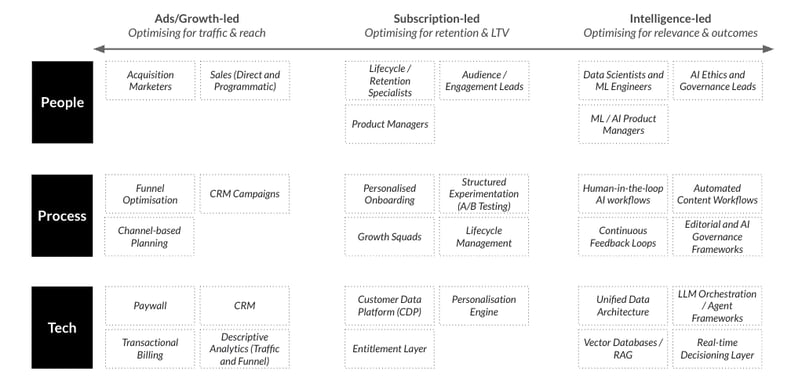
This is where the TOM comes in, serving as a roadmap that documents the necessary structure, logic and processes that the business needs in order to deliver on the value promised to customers.
In the media, the absence of a clear TOM often shows up in familiar ways:
- A predominantly advertising revenue-based publisher may set ambitious subscription targets without building the retention, lifecycle marketing or product capabilities needed to sustain them.
- A broadcaster makes substantial investments in AI tools without clear governance on where those tools should be used, who owns them or how quality and risk should be managed.
- A legacy publisher’s newsroom may be restructured without redesigning the workflows or acquiring the right tooling that would allow teams to operate differently in practice.
In each case, the strategic ambition may be sound, but the organisation has not been designed around it. A well-designed TOM helps ensure the business is actually configured to deliver on its strategy by considering whether editorial, product, audience, technology and commercial teams are working to the same priorities; whether decision rights are clear; and whether workflows reflect how value is now created.
What are the benefits of a target operating model?
Returning to our house renovation analogy: if your strategy is the vision for your dream home, the TOM is the foundation, plumbing and framing that make it livable for the long term.
Without a fully realised TOM, it is unlikely that an organisation will be able to turn its strategic objectives into reality — the underlying problems simply persist beneath the surface. This happens more often than most would admit: according to BCG, just 30% of transformations succeed in achieving their objectives, often due to poor or inadequate planning around the people, processes and technology that underpin a transformation.
At best, the result is that underlying issues persist and lead to stagnation and a demotivated workforce; at worst, organisations risk falling so far short of their goals that they must react with layoffs that might have been preventable with the right TOM in place. When cost reduction substitutes for operating model redesign, it rarely resolves the underlying problem: TOM design can be the difference between restructuring as reaction and restructuring as strategy.
While identifying the right TOM does not guarantee a successful transformation on its own, it greatly improves the odds by:
- Fostering organisational alignment: All employees can look to the TOM as a compass that ensures their everyday operations are continuously aligned with the organisational strategy.
- Uncovering and improving areas of redundancy: For companies that have recently gone through a merger or those that have multiple brands sitting under them, a well-designed TOM will unlock efficiencies by eliminating duplicative processes that drive up human capital and operating costs.
- Encouraging adaptability: TOM design is fundamentally about future-proofing the business and enabling it to grow at scale by ensuring each functional layer of the business is continuously assessed, optimised and deemed fit-for-purpose in the face of new challenges and opportunities.
For leadership teams, that is the value of TOM. It allows organisations to move from reactive restructuring to intentional design — from changing shape in response to pressure, to building a model that is actually fit for strategy. In a market where media businesses are being asked to adapt faster and with fewer resources, that distinction matters.
FT Strategies has helped news and media organisations globally with baselining their existing operations and identifying the right target operating model to support their strategic objectives. To find out more about how we can help your organisation, please get in touch.
.png?width=768&name=North%20Star%20(2).png)