
Newsrooms around the world are still thinking about AI in terms of how much time it can save them, or how much they can increase their output. In doing so, they are missing out on the biggest potential value of AI - the creation of new value or experiences that were previously not possible. However, more mature newsrooms are starting to wake up to the idea of value creation through AI. This article outlines this shift and picks out some examples of newsrooms doing this well, as well as the implications for the media industry.
AI has been disrupting the media industry since the proliferation of GenAI, starting with the release of ChatGPT in November 2022. However, despite having had almost 4 years to experiment, publishers are still struggling to realise the full benefits of AI. This is because many publishers are largely still thinking of time-saving as the primary benefit.
As part of our Future Newsrooms Study 2026, we surveyed 448 newsrooms, with representation from each continent, to understand how newsrooms are adapting to a disrupted future, including disruption from AI. When asked about their primary KPI for AI success, Time savings was the most chosen option at 46%. Roughly one tenth chose each of Engagement (10%), Cost reduction (9%), Revenue impact (9%) and Volume (9%). A further 21% do not have a defined KPI for AI success at all.
During interviews, whilst newsroom leaders expressed a desire to link AI efficiencies to wider commercial or audience objectives, they currently default to time saved. This risks the idea that the newsrooms of the future will just attempt to do the same work, but with fewer resources. Indeed, 43% of those surveyed said that they expected AI to reduce headcount in the next three years, in comparison to 37% who disagreed.
Spending less time on the more arduous and repetitive tasks within the newsroom does theoretically free up more time for journalists to work on more value-add tasks. However, whilst efficiency may help publishers to trim their balance sheets, a focus on efficiency gains is not enough:
- Efficiency gains won’t give you a competitive advantage: creating content more quickly or with fewer resources won’t help to differentiate from your competitors. Differentiation can only come through building new capabilities or audience experiences.
- Producing “more of the same” content risks competition from AI-generated content: if AI is used to make more content, at a faster pace, that content might be more generic. Though AI-enabled, this content is itself more vulnerable to being bypassed or replaced by AI-generated content or summaries. To successfully adapt to AI, newsrooms shouldn’t be thinking about how they can produce more content (or the same volume with fewer resources), but how they can be producing differentiated content that can’t be bypassed with AI summaries.
With this in mind, FT Strategies created an AI Maturity Framework to show the different phases of AI use that publishers are in:
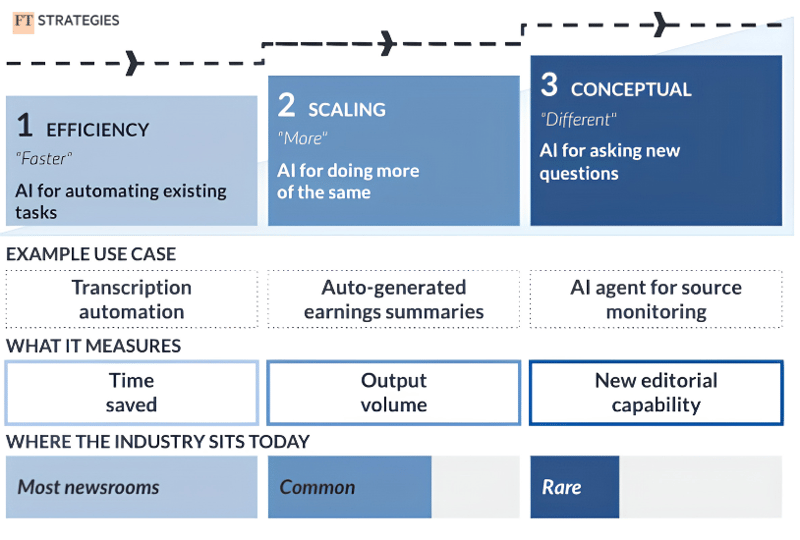
Source: Future Newsrooms Study
Today, few publishers are in the Conceptual stage but these publishers are best placed to survive and thrive in the AI age. However, it would be fair to ask: what do we really mean by Conceptual AI usage or “New editorial capability”? By this, we mean using AI to do things that were previously not possible, rather than simply doing existing tasks more efficiently. This could mean developing entirely new content formats, delivering more personalised audience experiences, or uncovering stories and insights that would otherwise have been beyond the reach of journalists. The key distinction is that AI is not just helping publishers produce the same journalism faster, but enabling them to create entirely new value for their audiences.
While this remains an emerging area for many publishers, we are starting to see examples of what this looks like in practice. Through FT Strategies' AI Lab programme, we have worked with publishers to explore how AI can unlock new editorial capabilities and audience experiences, moving beyond efficiency gains towards genuine value creation. A number of these experiments offer a glimpse of what the next phase of AI adoption in newsrooms could look like.
Example 1: A Nordic local media newsgroup
Across its network of more than a hundred local newsrooms, one leading Nordic regional publisher chose to go beyond efficiency gains to fundamentally rewire its editorial workflow from the ground up to create an AI-enabled newsroom. The initiative rejects the idea of AI as a speed boost, setting out instead to unlock new operational gains that were not previously possible.
One particular area of focus was the newsgathering process. In their model, background agentic workflows continuously monitor municipal public registries, local datasets, and digital signals at all times and proactively flags newsworthy stories. Crucially, this gives journalists the freedom to leave the office, pursue real human encounters, and double down on the authentic, in-the-field reporting that technology can never replicate.
Example 2: Regional Austrian Newspaper
One leading Austrian regional newspaper is exploring how AI can transform traditional articles into richer, more interactive experiences for readers. Rather than simply using AI to produce content more quickly, the publisher is developing a suite of AI-powered features that enhance its existing journalism, including interactive quizzes, simplified versions of complex articles, dynamic timelines and contextual follow-up questions.
Traditionally, readers have been limited to consuming articles in a largely static format, with few opportunities to explore topics in greater depth or engage with the content in different ways. Through these new AI-powered features, readers can test their understanding of a story, explore how events have developed over time, or access more digestible versions of complex reporting. Crucially, this creates entirely new ways for audiences to interact with journalism, making content more accessible and engaging while encouraging readers to spend more time with articles and develop stronger habits with the brand.
Conclusion
These examples demonstrate how AI can create value that goes far beyond time savings, whether through entirely new editorial capabilities or more engaging audience experiences. For publishers, the challenge is to move beyond asking “How much time can AI save us?” and instead consider “What can AI enable us to do that we couldn't do before?” This means asking where AI could help uncover stories that would otherwise go untold, create new ways for audiences to engage with journalism, or deliver value that competitors cannot easily replicate. Efficiency will remain important, but the publishers best placed to thrive in the AI age will be those that use the technology not just to do more with less, but to fundamentally rethink what they can offer their audiences.
At FT Strategies, we partner with news organisations to create and deliver AI strategies that seamlessly align with your editorial, audience and commercial ambitions. Through strategic guidance and practical implementation, we identify high-impact opportunities and strengthen the technical and organisational capabilities you need. Get in touch to discover how we can help your organisation harness AI to unlock innovation and achieve sustainable growth.