
Why structured AI training matters
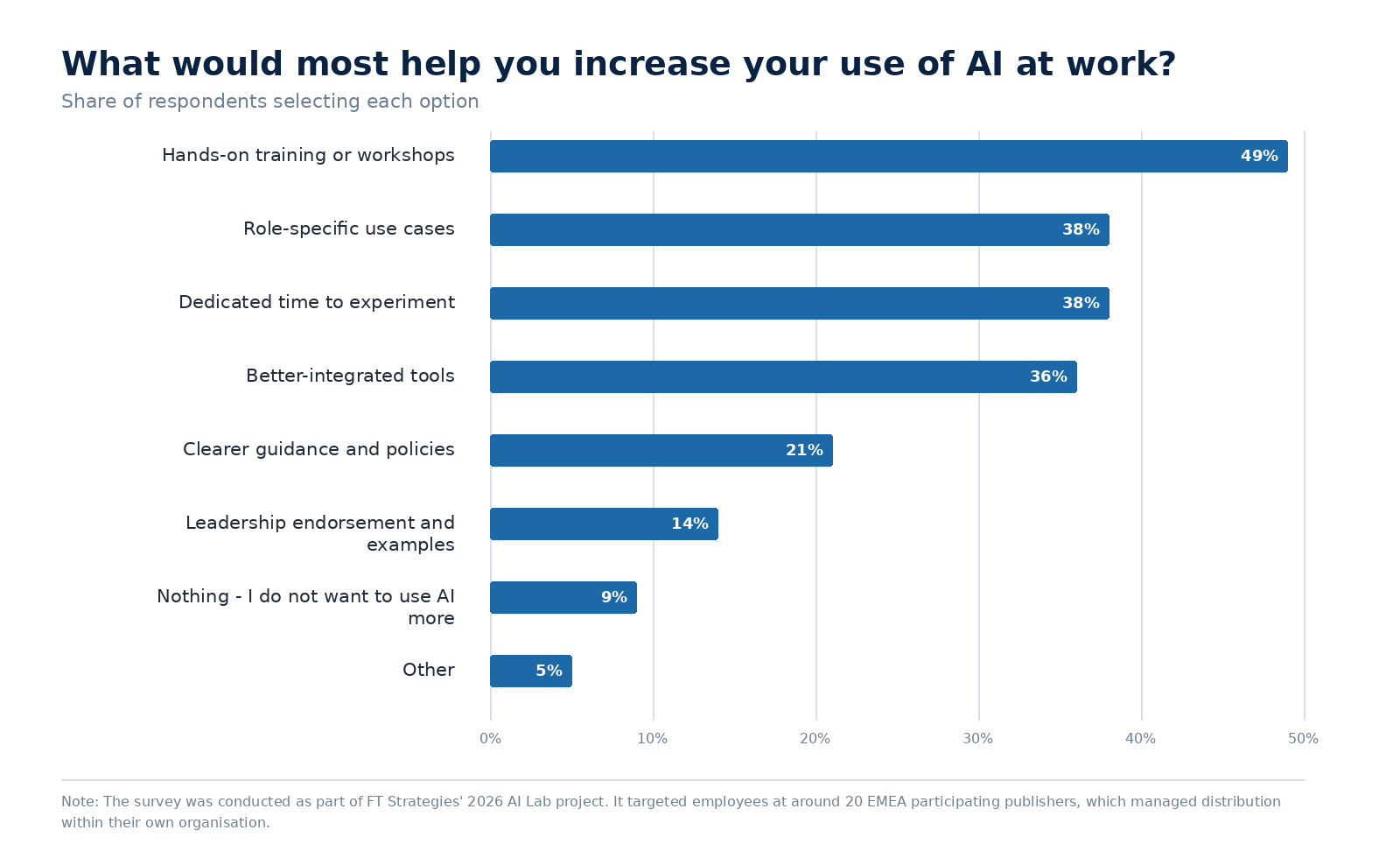
As more news publishers look beyond individual AI experiments towards wider organisational adoption, more publishers are looking to provide AI training internally to build the skills and confidence needed for wider adoption. Although there are many on-demand resources on AI skills freely available online, we recommend that publishers provide structured training rather than relying on employees to navigate these materials. Our Future News Study found that newsrooms with dedicated training resources reported higher average confidence in ability to meet both current priorities and future challenges. There also appears to be strong demand from potential trainees. In an internal AI attitudinal survey FT Strategies conducted with around 20 EMEA publishers in 2026 that collected over 2,500 responses, “Hands-on training or workshops” was cited as what would most help increase their use of AI at work.
Five lessons from a 12-week AI training project
In 2026, FT Strategies delivered a 12-week AI capability-building project for a large APAC news organisation. The project was primarily designed to build the skills of a group of 90 internal AI Champions, who were selected from 1,400 journalists and desk staff in its newsroom. This section explores five lessons learned from the project, from prep to the end of our engagement, to share practical considerations for publishers designing their own AI training.
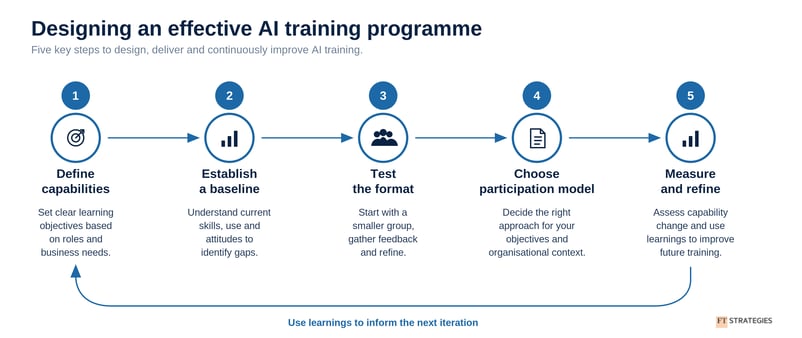
1. Define the capabilities you want to build
The first step is to define what participants should be able to do differently by the end of the project. The content will look very different depending on whether the aim is to give a broad group a baseline understanding of AI or to develop a smaller group of AI Champions who can support colleagues in their own teams.
For our recent client, the objective was the latter. We worked with them to define the capabilities AI Champions would need as follows:
- Understand how AI works and its main risks
- Be able to effectively use AI tools by creating prompts and refining outputs
- Be able to determine the right AI tools and approach when applying AI to their own work
- Be able to support wider adoption within their teams
- Contribute to the internal AI community building.
These desired capabilities create the foundation of the training series, as they helped shape the training content, assignments and overall project length.
2. Establish a baseline before designing the project
Once the target capabilities are clear, you should measure where your trainees are today. In our recent project, a pre-training survey provided a benchmark across AI use, fluency, awareness of risks, and confidence in the AI Champion role. This helped us identify where participants needed the most support and refine the project accordingly. A baseline also makes the eventual impact of training easier to assess - you can repeat the same measures after the project and distinguish perceived satisfaction from changes in capability and confidence.
3. Start small and test the format before scaling
For more hands-on topics, publishers should consider starting with smaller sessions before scaling. In our recent project, the main training sessions typically included around 20 - 30 participants. That said, we ran prompt engineering sessions in smaller groups of up to 10 participants, as these required more hands-on support. We listened to the challenges each participant faced with prompting and demonstrated how to address them. We used these smaller sessions to test what format and level of support worked best before considering how similar training could be delivered to a wider group.
Where relevant, grouping participants with similar roles, such as grouping journalists for one session and desk staff for another, can make examples and discussions more applicable to their day-to-day workflows.
4. Choose the participation model deliberately
Everyone is busy and needs to prioritise how to allocate their time, so the participation model needs to support the objective of the project. In our recent project, mandatory attendance helped maintain participation and signalled organisational commitment to AI. For other organisations, an opt-in model may be more appropriate, particularly where there is already a strong group of internal advocates. The key is to make expectations clear and remove practical barriers that prevent people from taking part.
5. Measure capability change, not just attendance or satisfaction
Evaluation should test whether participants can do things they could not confidently do before, not only whether they attended or enjoyed the sessions. We repeated the initial survey and complemented it with participant interviews to assess changes. After 12 weeks of training sessions, our survey and interviews indicated improvements across all the skill areas we had defined for AI Champions, including AI understanding, prompting, tool selection, day-to-day experimentation and confidence in supporting colleagues. Building on these positive results, the client is now looking to expand AI training beyond AI Champions to drive wider AI adoption across the organisation.
Beyond skills, training can reveal what is holding adoption back
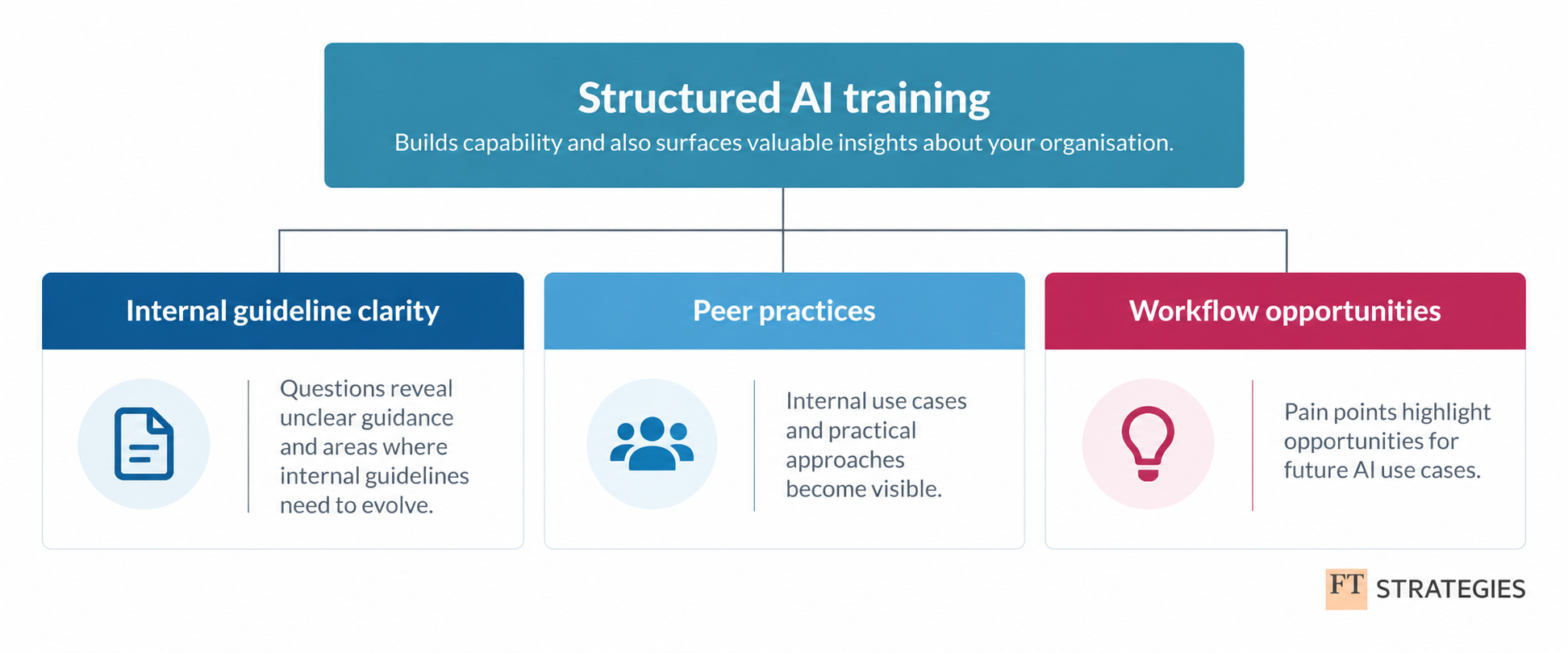
One of the most useful lessons from the project was that training can also act as an organisational diagnostic. Once journalists begin applying AI to real work, questions emerge about policies, workflows, access to tools and the support needed to move ideas forward.
- Training can show where policies need clarification: Our sessions created an opportunity to explain revised editorial AI guidelines while collecting questions and concerns from participants. This helped surface where further internal communication was needed and where policies were difficult to apply in day-to-day work. As AI tools and associated policies continue to evolve quickly, these feedback loops become increasingly important for maintaining responsible use and audience trust.
- Internal examples can make learning more relevant: The sessions also surfaced innovative ways journalists were already using AI. Some participants shared custom prompts they had developed to reduce hallucination risks or support creative brainstorming. These examples were particularly useful because colleagues could see how AI was being used by people working within the same tools, policies and editorial context, rather than having to translate generic online advice into their own workflows.
- Training can feed the future AI use case pipeline: Group discussions on workflow pain points also became useful inputs into the client's future AI product roadmap. They gave the project team a clearer view of unmet needs, potential AI use cases and colleagues who could become collaborators when new tools are developed or procured. In this way, training can support both capability building and opportunity discovery.
Training is only the beginning
Training is an important starting point, but it cannot scale AI on its own. This project reinforced that adoption is rarely uniform - employees begin from different levels of AI literacy and need different forms of support. Meaningful changes in AI adoption also depend on leadership, internal communication, governance, access to appropriate tools and clear processes for progressing new use cases.
Structured training can build capability, create internal champions and surface the barriers that need to be addressed next, but these wider organisational conditions determine whether adoption becomes sustainable. There is no shortcut. The key is treating training as part of a broader organisational change project rather than as a standalone intervention.
At FT Strategies, we help publishers build the skills, confidence and organisational capabilities needed to scale AI adoption. Drawing on our first-hand experience designing and delivering AI training programmes for news organisations, we can assess your team's current capabilities, develop tailored training programmes and support the wider organisational changes needed for sustainable AI adoption. Get in touch to explore how we can help your organisation embed AI effectively and responsibly across your teams.
%20(67).png?width=768&name=Hero%20Image%20(website%20banner)%20(67).png)
.png?width=768&name=Robots.txt%20as%20strategic%20intent%20analysis%20of%20large%20publishers%E2%80%99%20practices%20and%20policies%201%20(2).png)